Last updated: September 10, 2026
Key Takeaways
- Test both after running each for 1 minute.
- Any nearby construction, hydrant flushing, flooding, plumbing repair, or water-heater service in the last 7 days?
- For lead, take a first-draw sample after water has sat unused for at least 6 hours.
- Let a glass sit for 1 to 2 minutes.
Table of Contents
- Who this guide is for — and what I’m assuming you already have
- What home water quality problems usually are
- How do I tell what’s wrong with my water?
- What the common symptoms usually mean
- When should I stop guessing and get the water tested?
- The mistakes people make with home water problems
- What to do about the problem once you know what it is
Odd smells. Rust stains. Grit in the sink. Cloudy water in a glass. Those are the clues most people notice first, and they usually point to something specific rather than a vague “bad water” problem. So the real question is not “Is my water bad?” It is: what kind of home water quality problem is this, what can wait, and what needs testing or treatment right now? Home water quality problems — complete guide readers usually need that answer, because the issue is typically one of three things: a health concern, a nuisance, or a plumbing fault that only looks like a water issue. For municipal water, the EPA’s Consumer Confidence Reports are a solid starting point; the CDC and your state health department can help with health-related questions.
Who this guide is for — and what I’m assuming you already have
Homeowners, renters, and property managers are the audience here — anyone trying to make sense of drinking water, shower water, or household water from a municipal supply, a private well, or a building storage system. I’m assuming you can shut off a faucet, pull an aerator, and read a basic water report if one lands in your hands. And I’m also assuming you know the difference between “this looks strange” and “someone may be getting sick,” because those are not the same problem.
No need to panic over every symptom. A white crust on a kettle is usually hardness, not poison. A sulfur smell after water sits for a long time can come from plumbing or the water heater. On the other hand, if a baby, pregnant person, or anyone with a weakened immune system is drinking the water, I’d be a lot less relaxed about “probably fine.” Honestly, that’s where caution beats optimism. For health-related questions, I’d call in local public health, a certified lab, or your water utility instead of guessing. The CDC and EPA both recommend testing and professional guidance when there is a possible health risk.
This guide is not a “best filter” shopping list either. One cartridge will not fix chlorine, lead, PFAS, hardness, iron, bacteria, and sediment all at once — that math stops working fast. A $30 carbon pitcher and a $3,000 reverse osmosis system solve different problems, and either one can be the wrong pick if you do not know what is actually in the water.
Here’s the practical line: if the issue is taste, odor, staining, scale, or cloudiness, start by spotting the pattern yourself. If it’s a boil-water advisory, a known well problem, a lead service line, or a sudden color change after plumbing work, treat it as a testing problem first and a treatment issue second. Unsure? Check with your water utility, local public health department, or a certified water professional. The EPA’s “Consumer Confidence Reports” for municipal water and your state health department’s well guidance are useful places to begin.
What home water quality problems usually are
Most complaints fit into a few buckets: physical, chemical, biological, or plumbing-related. That framework matters, because the fix changes completely depending on which bucket you’re dealing with. Cloudy water after the tap runs for 30 seconds is not the same as water that smells like rotten eggs after the water heater cycles. A blue-green stain in a sink points somewhere else than reddish-brown sediment in a toilet tank.
Physical problems are the easiest ones to see. Sediment, rust flakes, cloudy water, and particles all fall in this group. They often come from aging pipes, disturbed mains, a failing water heater, or a well drawing in silt after rain. When the cloudiness clears from the bottom up in a glass after a minute or two, it may just be trapped air. Bubbles look milky and vanish. Sediment sinks. Simple, but not always.
Chemical issues are usually invisible. Hardness, iron, manganese, chlorine, chloramine, nitrate, fluoride, lead, copper, arsenic, and PFAS may not change the look of the water at all. Hard water is not a poison problem, yet it makes soap act badly, leaves scale, and shortens appliance life. Lead is different. There is no safe level of lead exposure for children, and the source is often plumbing rather than the water coming into town. The EPA Lead and Copper Rule and local utility materials matter here, because the route into the home matters as much as the city supply itself.
Biological problems cover bacteria, viruses, and protozoa such as Giardia and Cryptosporidium. They show up more often in private wells, after flooding, after a boil-water advisory, or when a backflow event has happened. A well can look perfect and still be unsafe. If you rely on a well, the question is not “does it taste okay?” but “what do the certified lab results say this month?” For well-water basics, see the CDC’s private well guidance and NSF’s water testing resources.
Plumbing-related problems are the sneaky ones. A bad-anode water heater can create sulfur odor. Copper pipes can leave blue-green staining and a metallic taste if the chemistry is aggressive. Galvanized pipes can shed rust and lower pressure. Old solder, brass fittings, and flexible supply lines can add lead or metals. In those cases, the source water may be fine, and the house itself is the culprit. Classic, really.
The mistake I see most often is treating all bad water as one issue. The EPA and CDC both stress matching the test to the likely contaminant, because that prevents buying the wrong filter, over-treating water that was fine, or brushing off a real hazard because the stain looked like “just rust.” The smart move is simple: identify the symptom pattern, then match it to the likely source.
How do I tell what’s wrong with my water?
Start with symptom, timing, source, and a few plain checks before spending money on treatment. That is the quickest way to narrow things down without making up a diagnosis.
- Check whether the problem is at one fixture or the whole house. Run cold water at the kitchen sink, bathroom sink, shower, and an outdoor spigot for 30–60 seconds. Verify whether the odor, color, or cloudiness appears everywhere or only at one tap. When it is isolated, the culprit is often a fixture, aerator, cartridge, or local branch line. When it shows up in multiple places, the issue is upstream or in the main plumbing run.
- Separate hot water from cold water. Test both after running each for 1 minute. Verify whether only hot water smells like sulfur or looks rusty. If only hot water is affected, suspect the water heater, anode rod, or heater sediment, not the incoming supply. If both are affected, look at source water, distribution pipes, or a whole-house issue.
- Use a clear glass and a white background. Fill a 12-ounce glass and hold it against white paper or a white sink. Wait 2 minutes. Verify whether the cloudiness disappears, settles, or remains. Cloudiness that clears is often air. Cloudiness that settles can be sediment. Cloudiness that persists may need testing, especially if it coincides with a boil advisory or a change in utility work.
- Inspect the aerator and showerhead. Unscrew the aerator and look for grit, rust, or white scale. Rinse it into a paper towel. Verify whether debris is inside the fixture. If yes, the issue may be local buildup or pipe corrosion. If the debris returns quickly after cleaning, upstream corrosion or sediment is likely.
- Check for staining patterns. Blue-green stains suggest copper and acidic water. Red-brown stains suggest iron or rust. Black staining can point to manganese or biofilm. Verify whether the stain appears in sinks, toilets, the tub, or only around a specific faucet. A repeatable stain pattern is more useful than a vague complaint about “dirty water.”
- Review your water source and recent events. Ask: municipal or well? Any nearby construction, hydrant flushing, flooding, plumbing repair, or water-heater service in the last 7 days? Verify whether the problem began suddenly after one of those events. Sudden onset after work on the system often points to stirred-up sediment or a pressure disturbance.
- Collect a sample the right way if you plan to test. Use a clean, lab-provided bottle if possible. For lead, take a first-draw sample after water has sat unused for at least 6 hours. For some other contaminants, you may need a flushed sample. Verify the lab instructions exactly; if you mix up first-draw and flushed samples, the result can mislead you badly.
- Match the symptom to the likely test. If you have odor, stain, or scale, ask for the relevant panel rather than a vague “water test.” Verify that the lab is certified for your state. If the issue is health-related, the right panel may include total coliform, E. coli, lead, nitrate, arsenic, or hardness depending on the source. A broad home strip kit can be useful for quick screening, but it is not the same as a certified lab result.
The point of these steps is not to diagnose everything yourself. It is to avoid the classic waste: buying hardness treatment for a chlorine smell, or blaming the city for a water-heater problem. Fifteen to thirty minutes is usually enough for a first pass, and that often tells you whether the next move is a fixture cleaning, a plumber, a utility call, or a certified test.
What the common symptoms usually mean
Taste and smell clues help, but only if you read them carefully. A chlorine smell usually means disinfectant is present, which can be normal in municipal water. Chloramine, a combined disinfectant used by some utilities, can smell weaker than chlorine but still bother taste-sensitive people. An activated carbon filter can reduce both, though carbon has limits and needs replacement on schedule, often based on gallons or months from the manufacturer’s specification.
Rotten egg? Sulfur. Usually hydrogen sulfide gas. In a well, it can come from groundwater chemistry or sulfur bacteria. In a home, the water heater is a frequent source, especially if the odor shows up only in hot water. That distinction matters, because a whole-house treatment system is overkill if the water heater is the problem. I would not start by buying a salt-based softener unless hardness is also present and verified.
Metallic taste can point to copper, iron, zinc, or low pH. Acidic water can dissolve metals from pipes. If you taste metal and see blue-green staining, copper corrosion deserves attention. If the taste comes with reddish water after the tap sits unused, galvanized piping or iron sediment may be involved. That is a plumbing issue as much as a water chemistry issue.
White spots on dishes, scale on faucets, and soap that won’t lather are classic hardness signs. Hardness is measured in grains per gallon or milligrams per liter as calcium carbonate. It is a nuisance, not a universal health threat, but it pushes people to drink less water because the taste and film are annoying. A softener or a template-assisted crystallization system can help with scale, and each has trade-offs. A softener needs salt and maintenance; a non-salt conditioner may reduce scale but does not actually remove hardness minerals.
Cloudiness is not always contamination. Fine bubbles from dissolved air often show up after pressure changes or seasonal temperature shifts. Let a glass sit for 1 to 2 minutes. If it clears, it is likely air. If it leaves grit, that is different. If it stays hazy and coincides with illness, a boil-water advisory, or a well concern, do not shrug it off. When cloudiness is new and unexplained, call a certified lab or your water utility.
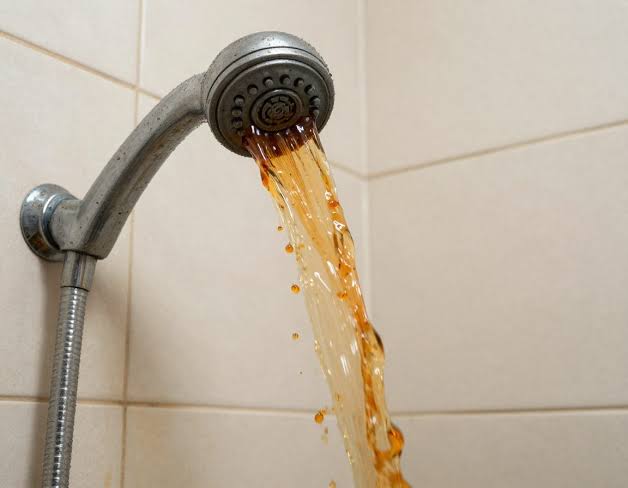
Stains tell their own story. Rust-colored staining usually comes from iron. Black staining may be manganese or bacteria. Blue-green staining points to copper. Pink film on shower walls is usually a biofilm that grows in damp places; it is more of a cleaning issue than a water-supply diagnosis, though high humidity and low disinfectant residual can make it worse.
The detail people miss is overlap. A sulfur odor can come from water, a drain, or a water heater. A metallic taste can come from source water, new plumbing, or stagnant water in a leaded fitting. That is why symptom-based diagnosis works only when you pair it with source and timing. Otherwise it gets slippery fast.
When should I stop guessing and get the water tested?
Stop guessing when the problem could affect health, when it is new and unexplained, or when the symptom does not fit a simple household cause. In those cases, testing is not optional if you want a trustworthy answer.
Private well water with any new taste, smell, or color change: This can mean the well casing, aquifer, or nearby runoff has changed — get a certified lab test, including total coliform and E. coli at minimum, and add nitrate, arsenic, lead, or other local concerns based on your region. The CDC and state health departments recommend routine well testing and prompt follow-up for changes.
Any household with a baby, pregnant person, or immunocompromised resident and suspected lead, nitrate, or bacterial contamination: These exposures can matter at low levels — use bottled water or an approved safe source until you have a proper result and a plan. For health-related concerns, consult your pediatrician, clinician, or local public health office.
Blue-green staining, metallic taste, or greenish water: This can indicate copper corrosion or acidic water — test pH, copper, and lead, and have the plumbing inspected if the water sits in old pipes for hours.
Brown water after municipal flushing, construction, or pipe work that does not clear within 24 hours: This may be sediment or corrosion in the system — call the utility and document the time, faucet, and sample appearance before assuming it is harmless.
Rotten-egg odor only in hot water: This often points to the water heater or anode rod rather than the supply — have the heater checked before buying a whole-house treatment system. If you are not sure, consult a plumber or water treatment professional.
Any boil-water advisory, flood event, sewer backup, or cross-connection/backflow incident: These can introduce pathogens — follow the advisory, disinfect or test as directed, and do not rely on appearance or smell to judge safety. The EPA and CDC both advise treating these as immediate safety events.
Known lead service line, lead plumbing, or pre-1986 plumbing with a child in the home: Lead risk rises with stagnation and corrosion — use first-draw lead testing and consider immediate exposure reduction while you wait for results. If you cannot confirm the plumbing materials, consult your utility or a licensed plumber.
Persistent odor from one faucet only after aerator cleaning and flushing: The issue may be in the faucet body, supply line, or local biofilm — if it persists, replace the fixture or have it inspected rather than treating the whole house.
A good rule of thumb: if the problem is temporary, isolated, and clearly tied to a fixture, you can often troubleshoot it. If it is persistent, health-related, or tied to a source like a well or lead plumbing, testing comes first. A solid lab report beats a hundred guesses, and a certified professional can help interpret results when the pattern is not obvious.
The mistakes people make with home water problems
The biggest mistake is treating symptoms instead of causes. A filter can hide taste while leaving lead, nitrate, or bacteria untouched if it is the wrong type. That gives you false confidence. The better move is to identify the contaminant class first, then choose treatment matched to that class.
Another common error is using a home test strip as if it were a diagnostic lab. Strips can be helpful for a quick read on hardness, chlorine, or sometimes pH, but they are crude. The downside is either overreacting to a bad color match or underreacting to a serious issue. Use a certified lab when the issue affects health or when the reading will drive a treatment decision.
People also forget that hot water is not the same as cold water. If hot water smells bad, the water heater may be the source. Ignoring that can lead to unnecessary whole-house treatment. The better move is to isolate hot versus cold before doing anything else. A water heater flush, anode replacement, or temperature adjustment may solve the issue.
A fourth mistake is skipping fixture cleaning. Aerators collect grit, scale, and flakes. The result is mistaking a dirty faucet for contaminated plumbing. Clean the aerator and retest after 5 to 10 minutes of flushing.
Another error is assuming that “clear” means safe. Lead, nitrate, PFAS, and many pesticides do not change appearance. That can leave exposure untreated. Test based on source and risk, not just looks. If you are on a private well, a yearly bacteria test is a common baseline, but local geology and nearby land use may justify more. The EPA and CDC both provide testing guidance for these decisions.
Finally, people buy a treatment system without maintenance discipline. Carbon filters saturate, softeners run out of salt, UV systems need clean sleeves and power, and reverse osmosis membranes need periodic replacement. The result is a system that quietly stops doing its job. Choose the simplest system that handles the
Leave a Reply