Last updated: September 10, 2026
Key Takeaways
- A cartridge that needs replacing every 3 to 6 months is a different ownership cost than a media tank that is backwashed automatically.
- White crust on showerheads and kettle elements usually means hard water, which is calcium and magnesium scale.
- That distinction changes cost, pressure loss, and how much space the system needs.
- If the quote is vague, the final bill is usually where the surprise shows up.
Table of Contents

- What signs mean your home needs a water filter?
- How do I tell whether a filter will solve the problem?
- What should I check before I call for installation?
- How do I know if the installation is worth the cost?
- What are the common mistakes people make?
- When should I stop and choose a different approach?
- What does a good installation look like, and how long does it take?
- Which water problems need a different solution than a filter?
- FAQ
Brown water is a hard stop. So is fuel smell. Start with the water itself: taste, odor, stains, scale, and test results tell you more than a glossy box on a shelf. If you are trying to figure out how to know if your home needs water filter installation, I would treat that as a practical decision, not a guessing contest — look at the water, the plumbing, and the local source before you spend money, and consult a licensed water-treatment professional if you are unsure. This article applies to homeowners and renters with permission to modify plumbing, and it assumes you already know the difference between a faucet filter, a point-of-use under-sink unit, and a whole-house system. If your water is suddenly brown, smells like fuel, or you suspect contamination from lead, a broken treatment plant, or a plumbing failure, stop using that water for drinking and call your local utility or a licensed water-treatment contractor right away. The U.S. EPA’s private well guidance and local water utility reports are good starting points for how to know if your home needs water filter installation.
What signs mean your home needs a water filter?
Taste, smell, staining, scale, and test results are the real clues. Not the brand name. A home usually needs filtration when water causes a noticeable nuisance or when a specific contaminant shows up in a test. If you are trying to decide how to know if your home needs water filter installation, I would not buy a system just because “city water should be fine.” Municipal water can meet basic safety rules and still carry chlorine, sediment from old mains, iron, manganese, or hardness that makes dishes spotty and fixtures grimy. Private well water has a different risk profile and usually deserves more careful testing.
Start with what you can see and smell. Rotten-egg odor often points to hydrogen sulfide, a gas that can occur in wells and some plumbing systems. A metallic taste can signal iron, copper, or low pH interacting with pipes. White crust on showerheads and kettle elements usually means hard water, which is calcium and magnesium scale. Rust-colored streaks or a reddish tint often point to iron. Cloudy water that clears after a few seconds may be air, but persistent cloudiness can mean sediment. Strange, but true: water can look innocent and still be the problem.
Then look for context. If your neighborhood has aging service lines, if your home has galvanized plumbing, if you live on a well, or if you recently had plumbing work or a main break nearby, I would raise the odds that filtration or treatment is needed, and I would consult a licensed plumber or water-treatment professional before making a purchase. In older homes, the question is not only “Is the water safe?” but also “Is the water aggressive enough to corrode pipes or carry rust into fixtures?”
Do not mistake a fridge filter or an under-sink carbon cartridge for a whole-home solution. Those are point-of-use devices. If your laundry, showers, and appliances all show the same problem, the issue may sit upstream of the kitchen tap. The EPA and CDC both note that different treatment devices address different contaminants, so matching the device to the symptom matters.
How do I tell whether a filter will solve the problem?

A filter helps when the problem is the thing it is designed to remove; it does not help when the issue is hardness, corrosion, bacteria, or dissolved chemicals that need a different treatment. That is the first fork in the road. A sediment filter traps particles. Activated carbon reduces chlorine taste and odor and can help with some organic compounds. A water softener removes hardness by ion exchange, which is not filtration in the usual sense. An iron filter, oxidation system, reverse osmosis unit, UV disinfection system, and whole-house carbon tank each solve different problems.
The fastest way to sort this out is often a water test, but not always the only step. For municipal water, ask your utility for its Consumer Confidence Report, then compare it with what you see at home. For wells, a basic lab panel should include bacteria, nitrates, hardness, pH, iron, manganese, and any local concern such as arsenic or uranium if those are known in your area. If you are worried about lead, ask for a lead-specific test. A home test strip can be a quick clue, but it is not the final word for health-related decisions. In the U.S., the EPA explains private well testing and common contaminants, and state labs often give sample kits with instructions.
I would use this rule: if one symptom points to one category, choose a targeted system; if several symptoms overlap, start with testing before any installation. For example, chlorine smell plus sediment after a main break suggests a sediment prefilter and carbon may be enough. Hard water plus orange stains and low flow in fixtures suggests a softener may be the first fix, possibly paired with sediment filtration. Cloudy water plus bacteria in a well usually means treatment beyond a simple carbon cartridge, and a licensed professional should confirm the right approach. A filter that does not match the contaminant wastes cartridge life and money. That math stops working fast.
What should I check before I call for installation?
You should check the water source, the plumbing layout, the contaminant type, and the flow rate before you book anyone. I would not ask for a quote until I knew whether the job is point-of-use, point-of-entry, or both. Point-of-use means one faucet or one appliance. Point-of-entry means the whole home at the main line. That split changes cost, pressure loss, and how much space the system needs. According to the EPA, whole-house and point-of-use systems solve different problems, so the installation choice matters.
First, note the supply type: city water or private well. That single detail changes the likely contaminant list. Well owners usually need a pump, pressure tank, shutoff valves, and enough electrical access for certain systems, especially UV or iron treatment. City-water homes often need better sediment control, chlorine reduction, or lead mitigation at specific taps.
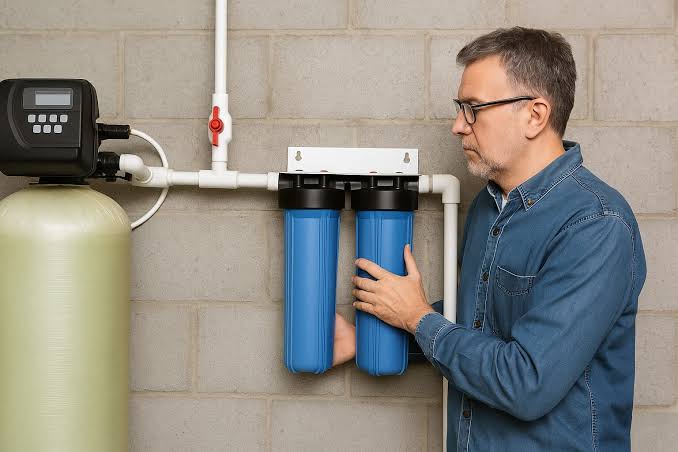
Second, check the main line location and available space. A whole-house unit needs room near the point where water enters the home, usually with enough clearance for a tank, bypass valves, and service access. If the main is in a crawlspace or tiny utility closet, installation can take longer and cost more. I would expect a straightforward retrofit to take a few hours; a cramped or older plumbing setup can take most of a day. In many cases, a plumber can tell you in 10 to 15 minutes whether the location is workable.
Third, get the numbers that matter: static pressure, flow, and hardness if scale is part of the complaint. Static pressure is the pressure with no water running. If pressure is already low, adding a filter with a large pressure drop can make showers and appliances worse. A contractor should be able to explain the expected pressure loss across the system and whether a 20-inch prefilter, a carbon tank, or a cartridge housing makes more sense. A 10-psi drop can be noticeable in homes that already start near the low end.
Fourth, ask what maintenance looks like. A cartridge that needs replacing every 3 to 6 months is a different ownership cost than a media tank that is backwashed automatically. The cheapest system to buy can be the most expensive to live with if cartridges are hard to find or the filters foul quickly. The CDC and EPA both recommend planning for maintenance before installation.
How do I know if the installation is worth the cost?
It is worth it when the problem is repeatable, measurable, and tied to a use case you care about. The purchase price is only part of the cost. Installation prices vary with the system type, plumbing access, and whether the job needs shutoff upgrades, new bypass valves, electrical work, or drain connections. A simple under-sink filter usually costs less to install than a whole-house filter or softener, but a whole-home system may save money if every showerhead, appliance, and faucet is affected. I am avoiding hard price claims here because local labor and equipment prices swing too much for a single national number to be honest.
Think in terms of avoided damage and daily friction. Scale shortens the life of heaters and fixture cartridges. Sediment can clog aerators and washer screens. Chlorine taste can make people avoid drinking tap water and push them toward bottled water. A system pays off faster when the home has multiple points of the same complaint. It pays off slowly when the issue is minor and limited to one kitchen faucet. EPA guidance on water efficiency and fixture maintenance supports that same logic.
Ask for a written scope before you agree to work. A good quote should say whether the job includes a pressure-reducing valve adjustment, bypass loop, new shutoffs, drain line routing, startup flushing, and filter media size or cartridge type. It should also say what happens if the plumber finds corroded pipe or a nonstandard main valve. If the quote is vague, the final bill is usually where the surprise shows up. A clear scope is especially useful on jobs that take 2 to 6 hours rather than 20 minutes.
What are the common mistakes people make?
The biggest mistake is treating every water problem as a filter problem. That leads to the wrong equipment and a complaint that never gets fixed. Hard water does not go away with carbon. Bacteria do not go away with a sediment cartridge. Lead mitigation is not the same as taste-and-odor reduction. The better path is testing first, then matching the treatment to the contaminant. The EPA and CDC both publish contaminant-specific guidance for this reason.
A second mistake is installing a system with too little capacity. A small cartridge housing on a whole-house line may clog fast, cut pressure, and create more maintenance than the homeowner expected. The better alternative is to size for peak flow and actual water use, not just the first month of operation. A typical home can see peak demand in the morning and evening, so the system has to handle those minutes, not just the average day. Small box, big headache.
A third mistake is ignoring pressure loss. Every filter creates some resistance. If your home already has weak pressure, a dense filter or undersized housing can make showers miserable. The fix is to check the system’s rated flow and pressure drop and choose a lower-restriction layout if needed.
A fourth mistake is skipping maintenance. Carbon loses effectiveness, sediment filters plug, and UV lamps have a service life measured in months, not forever. If you will not change cartridges on schedule, choose a simpler system or one with longer service intervals. Otherwise the home ends up with a dead filter that still looks installed. Many UV lamps, for example, are replaced on a 12-month schedule.
A fifth mistake is putting in a whole-house system when the issue is only one tap. That increases cost and complexity without much benefit. If the concern is drinking water at the kitchen sink, a point-of-use reverse osmosis unit or certified faucet filter may be the smarter move.
When should I stop and choose a different approach?
You should stop and change course when the symptom points to a safety issue, a plumbing defect, or a treatment need outside basic filtration. In those cases, a filter is the wrong first move.
Sudden brown, black, or oily water: This can mean main-line disturbance, corrosion, or contamination — stop using the water for drinking and cooking, contact the utility or a licensed plumber, and do not assume a filter will solve it.
Rotten-egg smell that gets stronger at hot taps: This may involve water heater bacteria, anode-rod reaction, or sulfur in the source — have the heater and source water evaluated before buying a filter.
Lead concerns in an older home: This is a health issue, not a taste issue — use a lead-specific test and choose treatment certified for lead reduction; if you cannot verify that, use another safe water source until you can.
Well water with bacteria or nitrate concerns: A sediment or carbon filter alone is not enough — ask for lab testing and appropriate disinfection or treatment such as UV or reverse osmosis, depending on the result, and consult a water-treatment professional.
Very low water pressure already in the house: A restrictive filter may make showers and appliances worse — fix the pressure problem first or choose a lower-pressure-drop system.
No easy access to the main line or a damaged valve setup: The installation may turn into a plumbing repair job — have the plumbing corrected before the filter goes in.
What does a good installation look like, and how long does it take?
A good installation is neat, serviceable, and matched to the water problem. I would expect labeled shutoffs, a bypass valve on whole-house systems, leak-free fittings, and enough room to change cartridges without dismantling half the cabinet. On an under-sink setup, the tubing should be secured, the drain connection should be clean, and the faucet should not wobble. On a whole-house system, the main line should be accessible, the unit should be level, and the installer should flush the system until fines and carbon dust are gone.
The timeline depends on scope. A simple point-of-use installation can take less than a day. A whole-house filter, softener, or multi-stage setup can take several hours, especially if the contractor needs to add shutoffs, reroute pipe, or install a drain. If the home has galvanized pipe, cramped access, or a badly placed main shutoff, the job can stretch longer because the plumbing has to be made serviceable first. In that case, the installation is really two jobs: plumbing prep and filter setup.
A good result has a clear before-and-after in the problem you were trying to fix. The chlorine smell drops, the sediment clears, the scale slows down, or the test result changes in the right direction. If the water still tastes wrong or the same stains return within a short time, the system is either undersized, the wrong type, or installed in the wrong place. That is not “normal settling in”; it is a sign the diagnosis was off.
I would also ask for the model or media specification, not just “a filter.” Terms matter. Activated carbon, pleated sediment, ion exchange, reverse osmosis, and UV each do different work. If the installer cannot explain which contaminant the system targets, I would not sign off yet.
Which water problems need a different solution than a filter?
Hardness, corrosion, bacteria, and some dissolved contaminants need treatment that may sit beside filtration, not inside it. Hard water is usually handled by a softener, not a filter. Corrosion can require pipe repair, pH correction, or material changes. Bacteria in a well may require UV disinfection, chlorination, or well service. Some dissolved contaminants, such as nitrate, arsenic, or fluoride, may need reverse osmosis or another certified treatment stage at the tap. The EPA’s drinking-water resources separate these treatment paths for a reason.
This is where local conditions matter. Well depth, nearby geology, old service lines, and municipal treatment practices all affect the answer. A home on granite-rich ground may fight different mineral issues than a home on clay or limestone. A city with chloramine disinfection creates a different odor and carbon demand than one using free chlorine. That is why I would never choose a system solely by a neighbor’s recommendation.
If you want a clean decision, keep the question narrow: what is in the water, where is the problem showing up, and what does each treatment remove? Once those three answers line up, the right installation becomes much easier to justify. That is the practical core of how to know if your home needs water filter installation.
FAQ
Can I tell if I need a water filter without a lab test?
Yes, but only for obvious nuisance problems like chlorine taste, sediment, rust, or scale. For health-related concerns such as lead, nitrate, or bacteria, I would not rely on appearance or taste alone. The EPA recommends lab testing for those concerns.
Is a whole-house filter always better than a faucet filter?
No. A whole-house system helps when the whole home has the same issue, but it costs more and can add pressure loss. If the problem is only drinking water at one sink, a point-of-use system is often the better fit.
How often do filters need changing?
It depends on the system and the water quality. A cartridge might need replacement every 3 to 6 months, while some larger media tanks are serviced much less often. The manufacturer’s schedule matters.
Leave a Reply